
Google site timeouts on Edge 147 & greater for Windows

Google has in partnership with Microsoft spent two years on an open web security standard called Device Bound Session Credentials (DBSC), which in essence is a process that binds your login credentials for any Google services session with your computer’s Trusted Platform Module (TPM), which is a security chip contained in your computer. The aim of DBSC is to make it difficult for malware to easily hijack access to your account and use it on another machines, something which I personally have fell victim to even with attention to solid passwords and multifactor authentication.
Post consultation and testing, Google commenced rollout of the new process in Chrome 146 for Windows which was publicly available in May 2026, with visible availability for the feature for Microsoft Edge in version 147.
A number of users online have raised concerns with being able to access any Google services after a random interval – with Edge browser failing to respond to a visit request and simply timing out. Cache clearing within Edge settings may resolve the issue temporarily, but it returns as soon as a Google DBSC request is raised to the system again.
At present there is no formal resolution which allows the DBSC setting to remain switched on for current builds of Microsoft Edge if you are experiencing this issue, so it’s currently advisable that you need to turn it off if you run the browser.
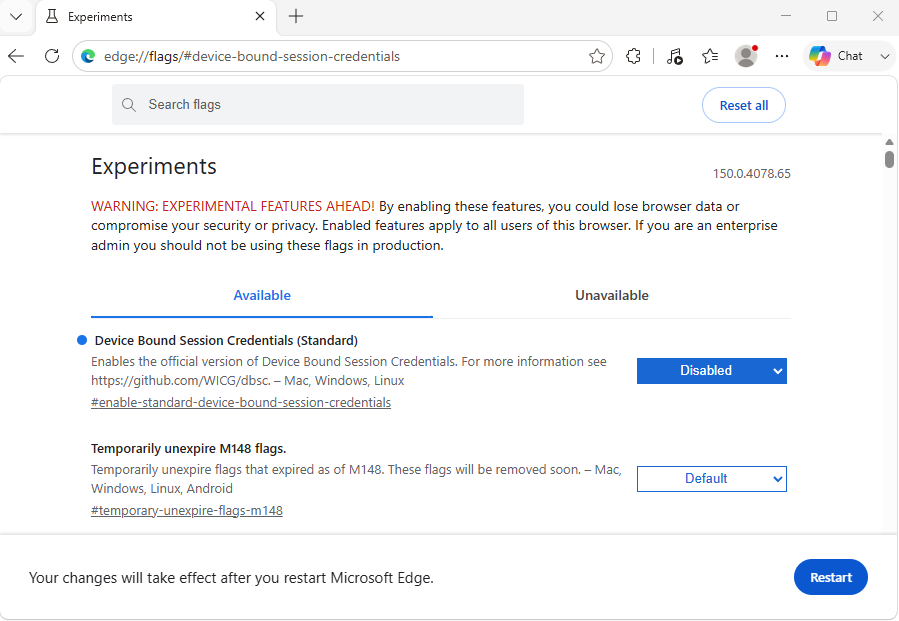
Disabling DBSC in Microsoft Edge is rather quick and easy and can be completed by following these steps:
- Open a new tab in Microsoft Edge and enter the following URL, pressing enter to launch the setting dialog.
edge://flags/#device-bound-session-credentials- At the top of the Experiments Available list that is displayed, you will find the option Device Bound Session Credentials (Standard). Click on the selectable drop box to the right of the description and select Disabled. Once a setting is changed you will see a Restart button appear to the bottom right of the window, click on this and all changes will be applied.
Microsoft has not committed to a timeline for full native DBSC support across all services despite working with Google to help design the standard. The companies current intentions are to prioritize it’s own native Microsoft Entra ID token protection from all documented accounts.